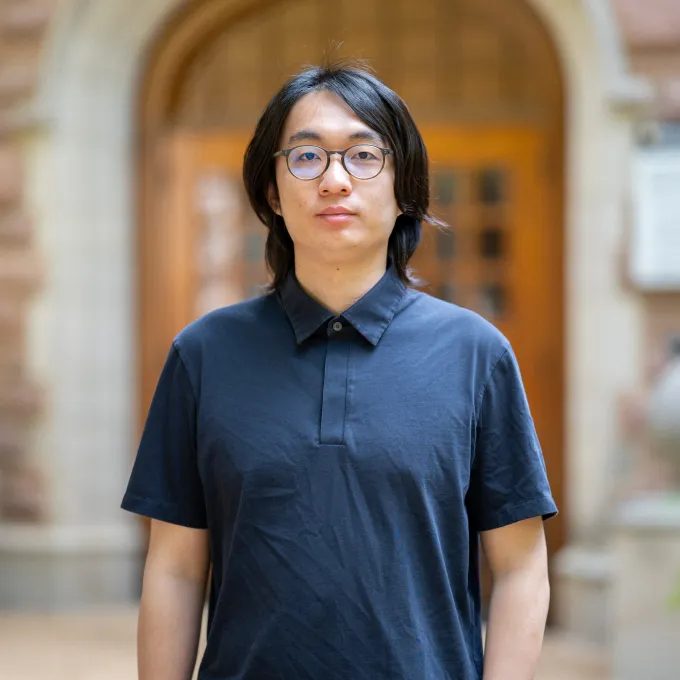
Physics graduate student Chun Huang has received the 2026 Dean’s Award for Graduate Research Excellence from Washington University in St. Louis’ Office of Graduate Studies in Arts & Sciences.
The award recognizes outstanding graduate student achievements in research, scholarship, and creative practice.
Chun Huang’s research explores some of the most extreme environments in the universe, focusing on pulsars and neutron stars. These incredibly dense stellar remnants offer scientists a way to investigate matter under conditions that cannot be reproduced in laboratories on Earth.
At the center of his work are two fundamental questions: What lies inside a neutron star, and what are the properties of the magnetic fields surrounding it?
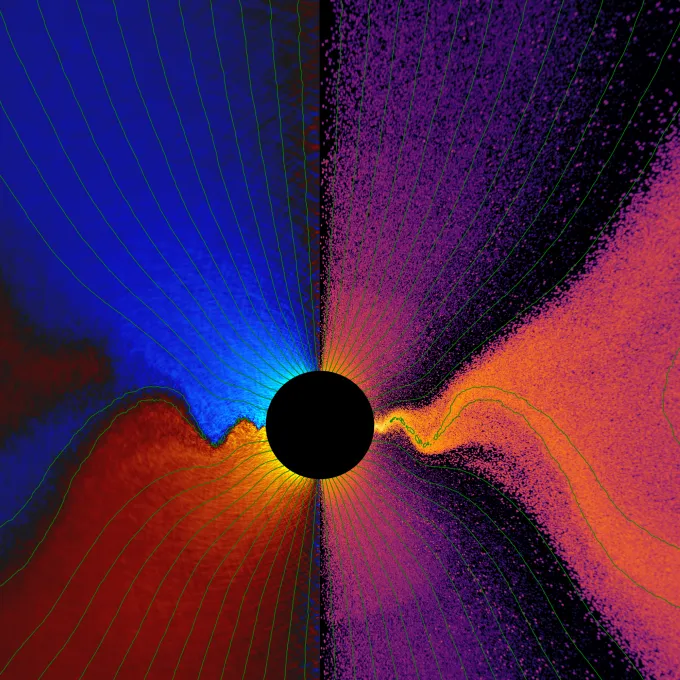
Huang uses X-ray observations to study these objects, including data from NASA’s Neutron star Interior Composition Explorer (NICER) telescope. By analyzing the X-ray pulses emitted as a neutron star rotates, researchers can estimate its size and use that information to constrain the properties of matter at extreme densities. However, those measurements depend in part on understanding how the star’s magnetic field heats its surface and produces the X-ray-emitting regions.
During his PhD research, Huang developed physics-based models to predict where magnetic fields heat a neutron star’s surface. He also conceived and supervised the development of a graphics processing unit (GPU) code with a student he mentors. The code runs 1,000 to 10,000 times faster than representative CPU-based codes, making it possible to fit these models to observational data more efficiently.
Looking ahead, Huang hopes to combine X-ray observations with radio and gamma-ray data to better understand neutron stars’ magnetic fields and improve estimates of their size. By bringing together observations across multiple wavelengths, his research aims to distinguish the effects of a star’s magnetic environment from the properties of the ultra-dense matter within it.
The Dean’s Award for Graduate Research Excellence celebrates outstanding research achievements by graduate students across Arts & Sciences. Huang’s recognition highlights his contributions to astrophysics and his work developing computational tools to investigate some of the universe’s most extreme objects.