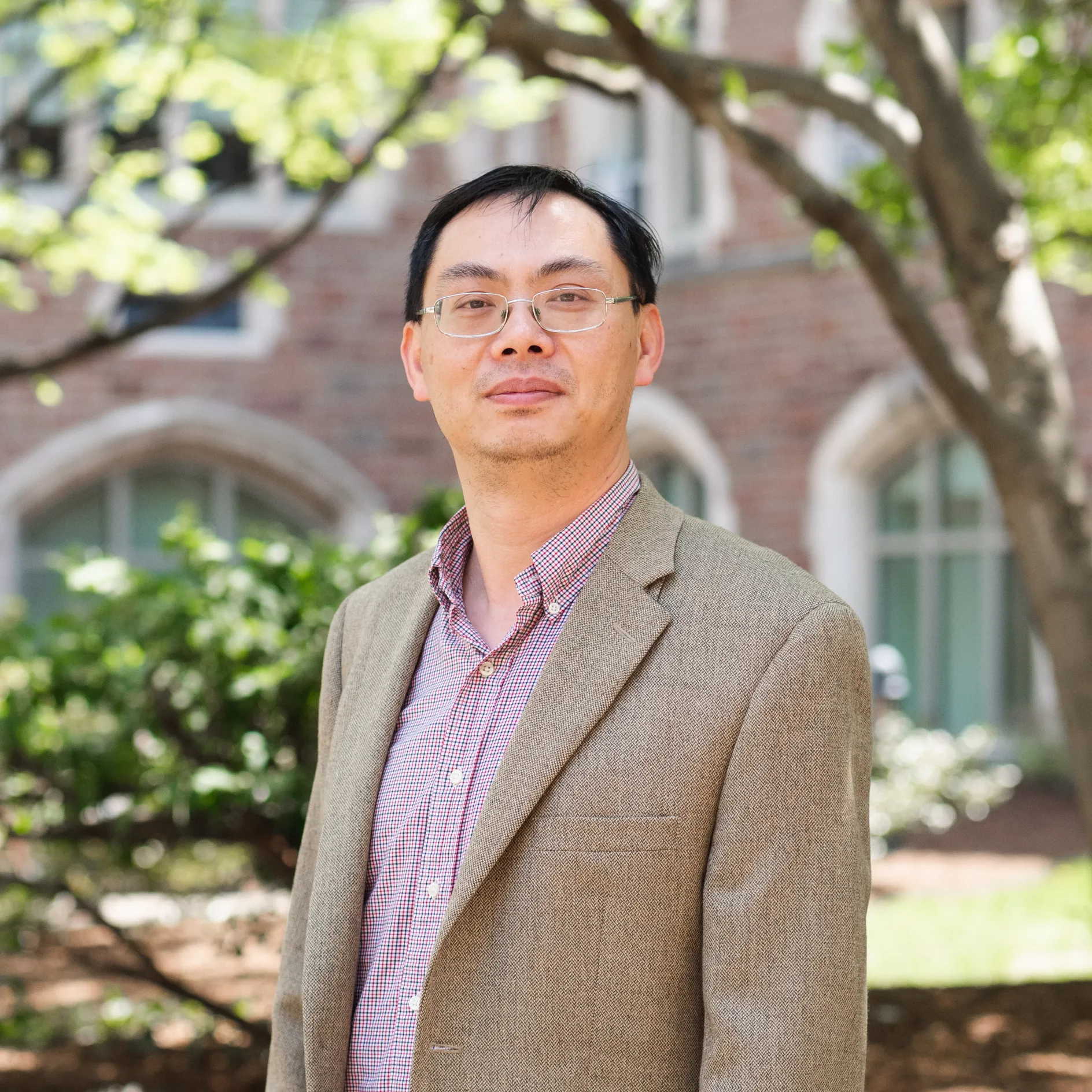
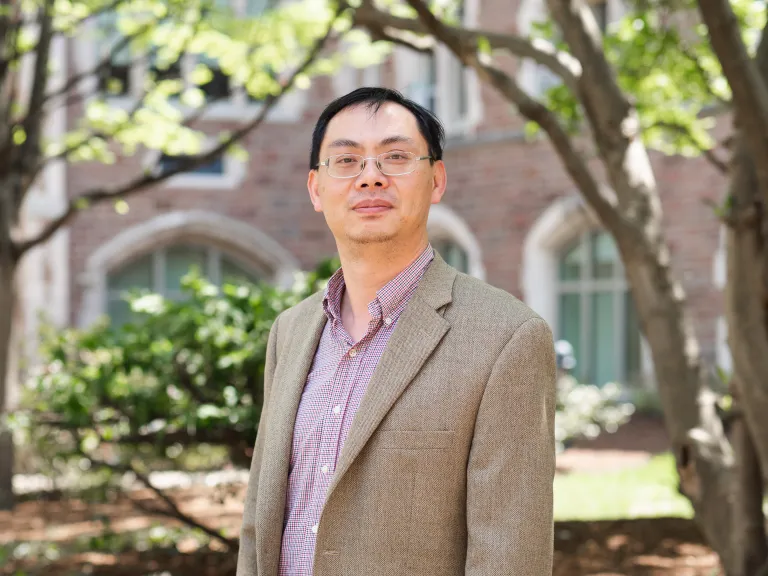
Li Yang

Li Yang

Li Yang

Professor of Physics
Albert Gordon Hill Professor of Physics
PhD, Georgia Institute of Technology
BA, Beijing Normal University
research interests:
  • Condensed Matter Theory
  • Material Physics
View All People

contact info:

mailing address:

  • Washington University
    MSC 1105-109-03
    One Brookings Drive
    St. Louis, MO 63130-4899

Professor Yang’s research seeks to understand how quantum mechanics gives rise to novel properties in materials and how those properties can be harnessed for future electronic, photonic, and energy technologies.

His group combines fundamental physics, large-scale first-principles simulations, and artificial intelligence (AI) to investigate the electronic structure and excited-state behavior of solids and nanostructures through predictive, parameter-free approaches.

Using density functional theory (DFT), many-body perturbation theory (MBPT), and machine learning, the group explores central questions in modern materials physics: how electron–electron interactions govern excited states and linear and nonlinear optical responses; how quasiparticles, excitons, spin waves, and phonons interact to produce emergent phenomena; how reduced dimensionality and quantum confinement can be harnessed to engineer topological transport and energy-related functionalities; and how new quantum materials can be discovered and controlled to realize electrical and magnetic polarizations for next-generation transistors, memory, and quantum devices.

By combining fundamental discovery with predictive materials design, Professor Yang’s group aims to uncover new quantum phenomena, guide experiments, and accelerate the development of functional materials for future technologies.

Professional History

2020-present: Professor, Washington University 
2015-2020: Associate Professor, Washington University
2009-2015: Assistant Professor, Washington University
2006-2009: Postdoctoral Fellow, University of California, Berkeley

Awards & Honors

2025 Fellow of the American Physical Society (APS)
2017-2025 The Highly Cited Researchers List by Clarivate Analytics (Web of Science)
2015 The Faculty Early Career Development Award (CAREER) from the National Science Foundation (NSF)

Recent Courses

Electricity and Magnetism (Physics 421)

The first course in a two part series covering the classical theory of electricity and magnetism leading to the derivation an application of Maxwell's equations. Vector algebra and calculus, electrostatics and magnetostatics in vacuum and in materials, Coulomb's Law, the Biot-Savart law, Gauss' law, and Ampere's law are covered. Multipole expansions and the solution of boundary-value problems by separation of variable, and the method of images are discussed.

Solid State Physics (Physics 472)

Crystal structures, binding energies, thermal properties, dielectrics, magnetism, free electron theory of metals, band theory, semiconductors, defects in solids.

Classical Electrodynamics I (Physics 505)

Classical electromagnetism in microscopic and macroscopic forms: electromagnetic fields of and forces between charged particles. Applications to electrostatic, magnetostatic, electrodynamic, and radiation problems.

Solid State Physics II (Physics 550)

Band magnetism and local moments, Ising models, electron-electron and electron-phonon interactions, superconductivity.

Quantum Mechanics (Physics 471)

Origins of quantum theory, wave packets and uncertainty relations, Schroedinger's equation in one dimension, step potentials and harmonic oscillators, eigenfunctions and eigenvalues, Schroedinger's equation in three dimensions, the hydrogen atom, symmetry, spin and the periodic table, approximation methods for time independent problems, quantum statistics.

Solid State Physics I (Physics 549)

Quantum theory of phonons in solids, thermodynamical properties, band theory of solids, free-electron and tight-binding approaches to electronic structure.