Physics graduate student Shakil Kashem has been selected for the 2026-27 Imaging Sciences Pathway (ISP) Trainee Fellowship
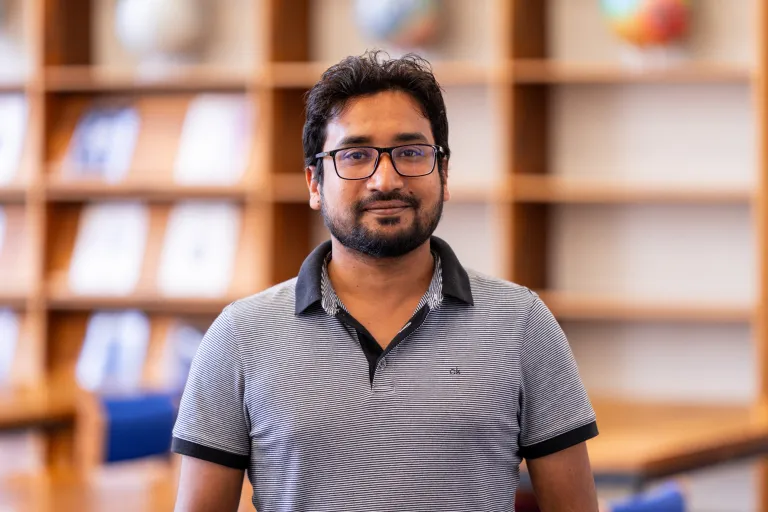
Physics graduate student Shakil Kashem has been selected for the 2026-27 Imaging Sciences Pathway (ISP) Trainee Fellowship, recognizing his research at the intersection of quantum sensing, imaging science and biomedical applications.
Kashem’s research explores how quantum-based imaging methods can reveal functional changes inside living cells, offering insights beyond what traditional imaging techniques can show. He is developing nitrogen-vacancy (NV) centers in fluorescent nanodiamonds as imaging probes that can simultaneously measure intracellular temperature, magnetic noise and emerging chemical signals in living cells.
The work brings together expertise from multiple disciplines, including quantum sensing, optical microscopy, nanodiamond probe development, quantitative image analysis and cell biology. By combining NV-based quantum sensing with cell biology and immunology, Kashem aims to apply these techniques to the study of mitochondrial dysfunction, immune-cell metabolism and disease-relevant primary cell models.
“My interest in developing quantum-based imaging science methods for biomedical applications comes from the need to move beyond imaging cellular structure alone toward imaging functional physiological states inside living systems,” Kashem said.
This interdisciplinary approach creates opportunities for physics-based technologies to address questions in biology and medicine. While quantum sensing provides new ways to measure physical properties at the cellular level, expertise in cell biology and immunology helps connect those measurements to biological processes and disease mechanisms. By bringing these perspectives together, Kashem’s research aims to advance both the development of new imaging methods and their application to understanding how living cells function. Ultimately, he hopes to establish nanodiamond NV centers as rigorous imaging-science probes for studying cellular disease mechanisms and evaluating therapeutic interventions.
Kashem’s research is supported by a collaborative mentoring team that includes Professors Shankar Mukherji and Chong Zu. Their involvement reflects the cross-disciplinary nature of the work, which requires expertise spanning the development of quantum sensing technologies and their application to biological systems. Through this collaboration, Kashem is working to connect advances in physics and imaging science with questions that could inform future biomedical research.
The one-year ISP Trainee Fellowship, awarded through the Division of Biological and Biomedical Sciences, supports Kashem’s research for the 2026-27 academic year.
Congratulations to Shakil on this achievement and his work bringing quantum sensing and biomedical research together!