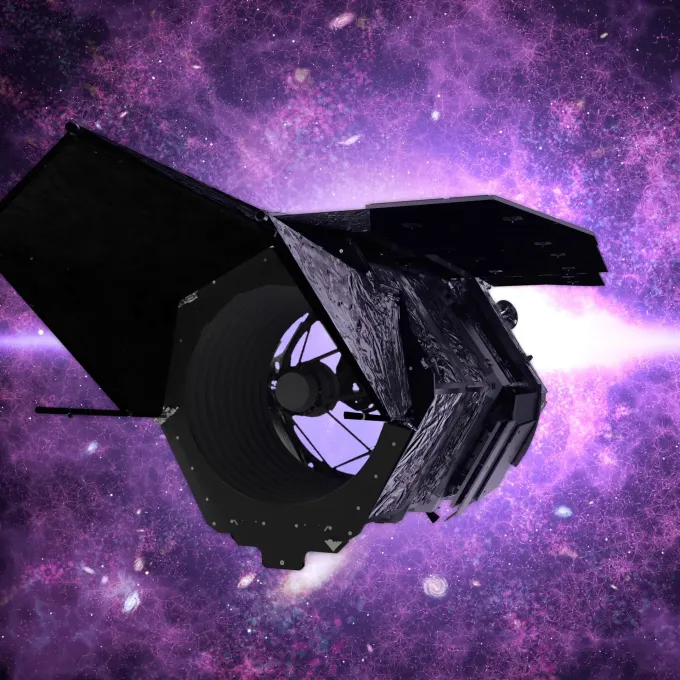

Zifan Lin and Tansu Daylan have been selected to lead one of the inaugural General Investigator programs for NASA's Nancy Grace Roman Space Telescope. Lin serves as principal investigator and Daylan as co-principal investigator of the program.
Their project is one of four Cycle 1 General Investigator programs involving WashU researchers that were recently selected for NASA's Roman mission. Scheduled to launch no earlier than August 30, Roman will conduct wide-field surveys to investigate dark energy, discover exoplanets, and address a broad range of questions in astrophysics.
Lin joined the Department of Physics at Washington University in St. Louis in 2025 as a McDonnell Postdoctoral Fellow and a member of the AstroMusers research group. His research focuses on exoplanets, transmission spectroscopy, and time-domain astronomy. Daylan is an assistant professor of physics and a fellow of the McDonnell Center for the Space Sciences.

The program, Transiting White Dwarf Exoplanets with the Galactic Bulge Time Domain Survey, will search for planets orbiting white dwarf stars using observations from Roman's GBTDS. The project will investigate the fate of planetary systems after their host stars exhaust their nuclear fuel and evolve into white dwarfs. As Sun-like stars expand into red giants, they engulf or gravitationally disrupt many of their planets. Yet observations of heavy elements in white dwarf atmospheres and dusty debris disks suggest that planetary material often survives this violent transformation. Whether intact planets remain common around white dwarfs, or whether new planets can form from the debris left behind after their host star becomes a white dwarf, remains largely unknown.
"To date, we know of only one transiting exoplanet orbiting a white dwarf, along with a handful of transiting disintegrating planetesimals," said Lin. "Roman may change this landscape by monitoring thousands of white dwarfs in the most densely populated region of the Milky Way."
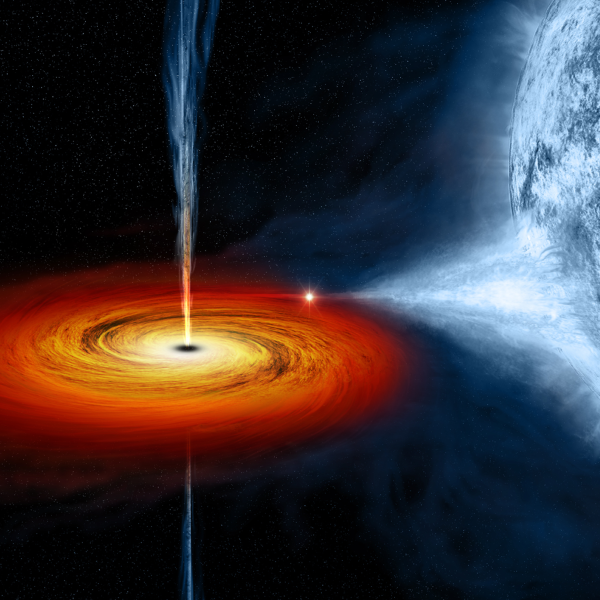
The WashU team will develop a specialized pipeline to search Roman observations for planets transiting white dwarfs. Because white dwarfs are approximately the size of Earth, even terrestrial planets can block a large fraction, or nearly all, of a star's light as they pass in front of it, creating some of the deepest planetary transit signals known.

"The challenge is that these eclipses typically last only a few minutes, requiring high-cadence observations with exceptional photometric precision," Daylan said. "Roman will provide exactly the kind of dataset needed to search for these rare events."
Roman’s Galactic Bulge Time Domain Survey is uniquely suited to this challenge. Over the course of the mission, the survey will repeatedly image dense stellar fields toward the center of the Milky Way, making precise brightness measurements for hundreds of millions of stars.
"A major challenge for the program is that we don't know for sure how many white dwarfs are in the GBTDS fields, and we don't know how frequent planets are around white dwarfs because only one data point is available," said Lin. "To solve this problem, we carried out an extensive simulation effort to quantify the number of white dwarf planets Roman will detect, based on stellar population models, transit models, and photometric simulations."
Daylan said, "With its high cadence, exceptional sensitivity, and enormous stellar sample, Roman’s Galactic Bulge Time Domain Survey will provide an unprecedented opportunity to discover transiting planets around compact stellar remnants."
The program will identify candidate white dwarfs within the Galactic bulge survey, produce precision light curves, and search for the distinctive, short-duration transit signatures expected from planets orbiting these compact stars. The team will develop automated detection pipelines capable of distinguishing genuine planetary transits from stellar variability, instrumental systematics, and other astrophysical false positives. Injection-and-recovery simulations will help determine how effectively the survey can detect planets spanning a wide range of orbital periods and sizes.
By either discovering the first statistically significant sample of transiting white dwarf planets or placing the strongest limits to date on their occurrence rate, the program will provide new constraints on the survival, dynamical evolution, and long-term stability of planetary systems. The resulting measurements will inform theories of stellar evolution, planetary system dynamics, and the ultimate fate of our own Solar System several billion years from now.