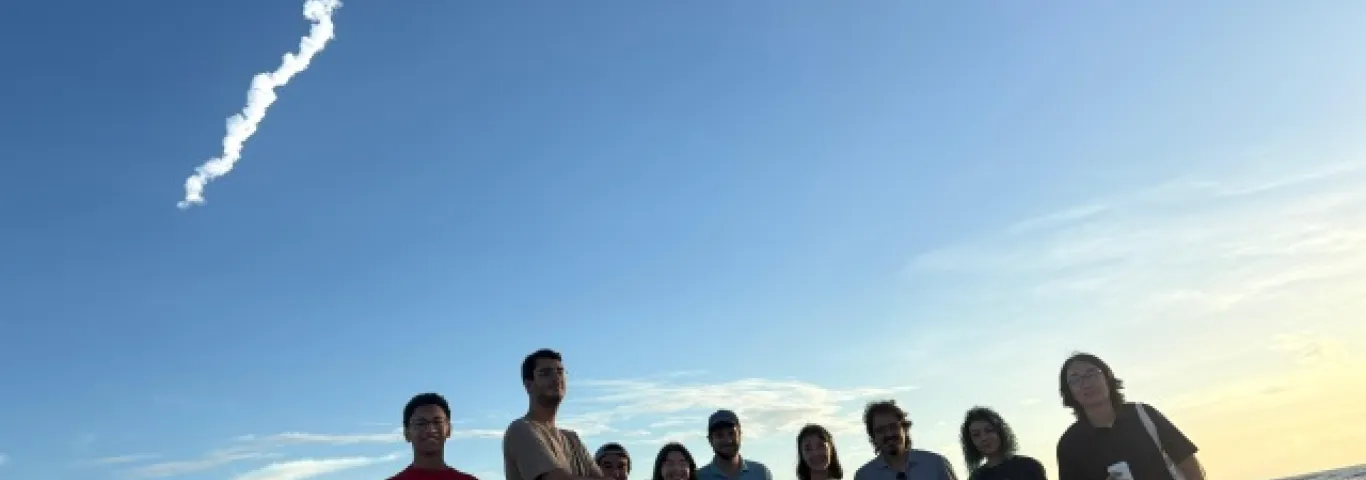

Early Sunday morning, Tansu Daylan, an assistant professor of physics at WashU and a fellow of the McDonnell Center for the Space Sciences, and members of his research group gathered along Florida's Atlantic coast to watch NASA’s Nancy Grace Roman Space Telescope rise into the sky.
Five graduate students, Asaf Kaya, Jacqueline Vazquez, Nathan Whitsett, Bryce Wedig, and Aysu Ece Saricaoglu, and postdoctoral researcher Zifan Lin joined Daylan in Florida for the August 30 launch, along with two group members based in Florida. They watched from Alan Shepard Park in Cocoa Beach, along with many others from the Roman Science Team.
"I'll admit I was a little nervous. Falcon Heavy wasn't just carrying a precious scientific instrument, but also the hopes and dreams of scientists eager for the discoveries it may lead to. I'm very glad everything went smoothly, and I'm excited to work with Roman’s data soon!" said Saricaoglu.
"Roman opens a new regime of precision astrophysics: wide-field, diffraction-limited imaging from space combined with the statistical power of enormous surveys," said Daylan. "Watching it launch early Sunday morning with my students and colleagues was a remarkable experience — seeing an observatory leave Earth that can transform what we know about both the inventory of the Universe and the architecture of planetary systems."
For the AstroMusers group at WashU, the launch marked the beginning of a new phase of work with a mission that will provide an unprecedented view of the Universe. Roman will observe enormous areas of the sky with a combination of sensitivity and resolution that will enable researchers to study phenomena ranging from exoplanets to dark matter and dark energy. Daylan's team leads one of the Wide Field Science programs and is involved in several Roman programs, including work to prepare for the tens of thousands of gravitational lenses the telescope is expected to discover.

The launch was the culmination of several days focused on Roman. Daylan and Lin attended the Roman Science Meeting and a NASA reception sponsored by the Simons Foundation in Cocoa Beach on Thursday. On Friday, Daylan gave a public talk about Roman at the Franklin DeGroodt Library in Palm Bay and met with colleagues over Friday and Saturday to discuss upcoming Roman science programs.
After the launch, Daylan organized a brunch for the research group before taking the students to the Kennedy Space Center Visitor Complex.